
LocalExtract vs CapyParse
Key Takeaways
- CapyParse is a cloud-based bank statement parser — you upload PDFs to their servers for processing. LocalExtract processes PDFs entirely on your computer with no upload.
- Both tools extract transaction data from bank statement PDFs. The fundamental difference is where your data goes during conversion.
- Cloud processing means your account numbers, balances, and transaction histories travel to CapyParse's servers. Local processing means they never leave your machine.
- LocalExtract works offline with no internet connection. CapyParse requires internet access.
- Pricing: LocalExtract offers a free tier (10 pages lifetime) and Pro at $10/month or $60/year. Check CapyParse's website for their current pricing and plans.
Disclosure: This article is published by the LocalExtract team. We are a competitor to CapyParse. Where we compare products, we strive for factual accuracy based on publicly available information from CapyParse's website. We note our own limitations honestly.
Contents
- Why Look for a CapyParse Alternative?
- What Is CapyParse?
- What Is LocalExtract?
- The Core Difference: Cloud vs. Local Processing
- Feature Comparison
- Accuracy and Bank Format Support
- Pricing Comparison
- Pros and Cons: CapyParse
- Pros and Cons: LocalExtract
- Who Should Choose CapyParse
- Who Should Choose LocalExtract
- FAQ
- What We Found in Testing
- Looking Ahead
- The Bottom Line
Why Look for a CapyParse Alternative?
If you are searching for a CapyParse alternative, you likely have one of these concerns:
- Privacy: You handle client financial data and want to avoid uploading bank statements to any cloud service.
- Offline needs: You need a converter that works without internet access — on-site at a client's office, during travel, or in a restricted network environment. See our offline bank statement converter guide.
- Pricing: You want a pricing structure that better matches your usage patterns.
- Desktop preference: You prefer a native desktop application rather than a web-based tool.
- Compliance simplification: You want to minimize the number of cloud vendors you need to document in your Written Information Security Plan (WISP) or FTC Safeguards Rule compliance documentation. Our data privacy guide for bookkeepers covers these requirements in detail.
These are valid reasons to evaluate alternatives. This article compares CapyParse and LocalExtract on the dimensions that matter most for bank statement conversion.
What Is CapyParse?
CapyParse is a cloud-based bank statement parser. You upload a PDF bank statement through their website, their servers extract the transaction data, and you download the structured output.
Key characteristics based on publicly available information:
- Cloud-based: Processing happens on CapyParse's servers. Your PDF is uploaded over the internet.
- Bank statement focused: The service is designed for parsing bank statement PDFs into structured data.
- Structured output: Converts bank statements to CSV, Excel, or other structured formats.
- Web-based interface: Access through a web browser without software installation.
- Multiple bank support: Handles statements from various banks and financial institutions.
CapyParse serves bookkeepers, accountants, and anyone who needs to extract structured data from bank statement PDFs.
What Is LocalExtract?
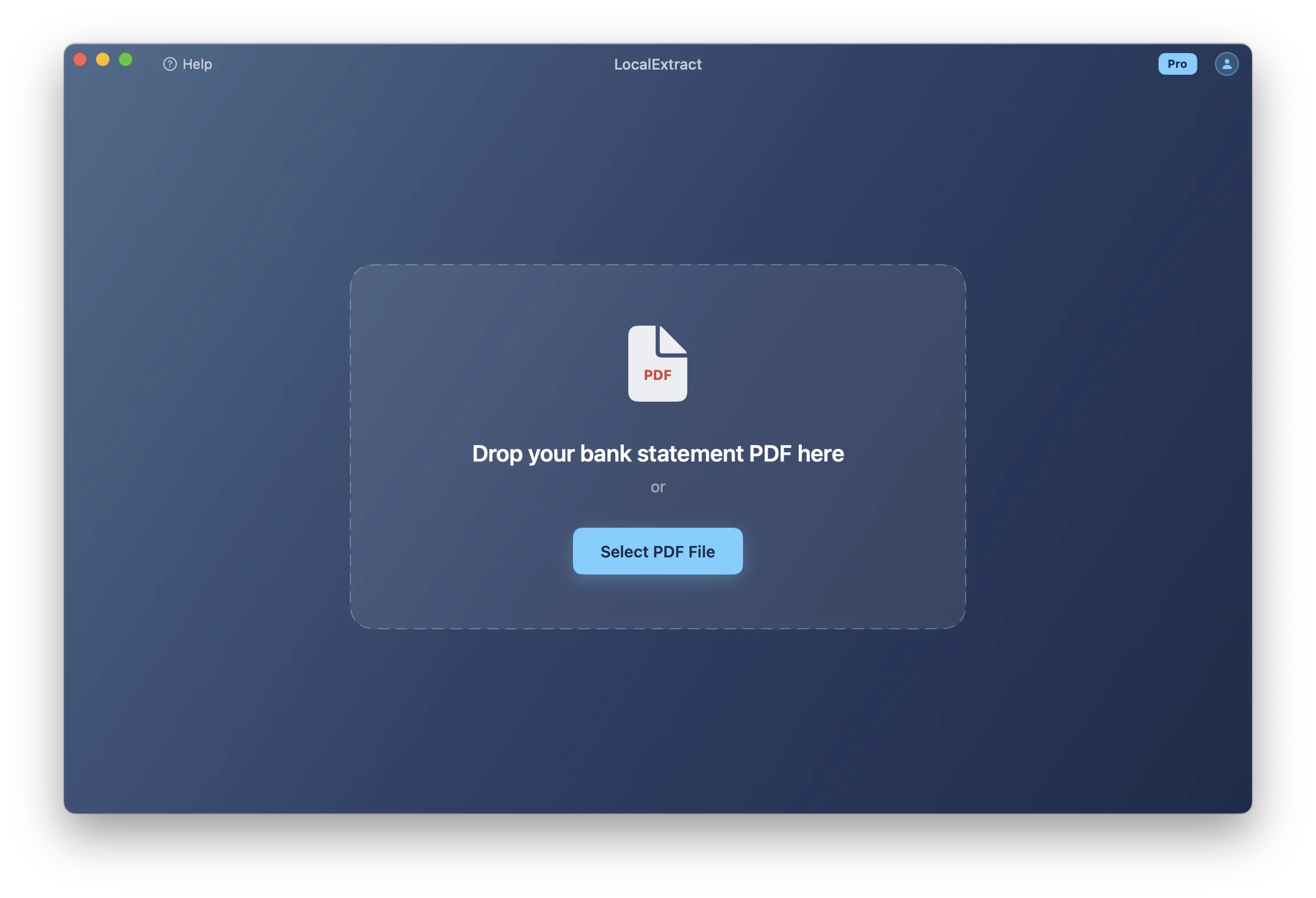
LocalExtract is a desktop bank statement converter for macOS and Windows. It runs a parsing engine entirely on your computer. No PDF is uploaded anywhere — the conversion from PDF to CSV or Excel happens on your local machine.
Key characteristics:
- 100% local processing: The parsing engine runs on your device. No data leaves your computer at any point during conversion.
- Offline capable: Works with no internet connection. You can verify this by disconnecting from the internet and running a conversion.
- Desktop application: Native apps for macOS and Windows — not a browser-based tool.
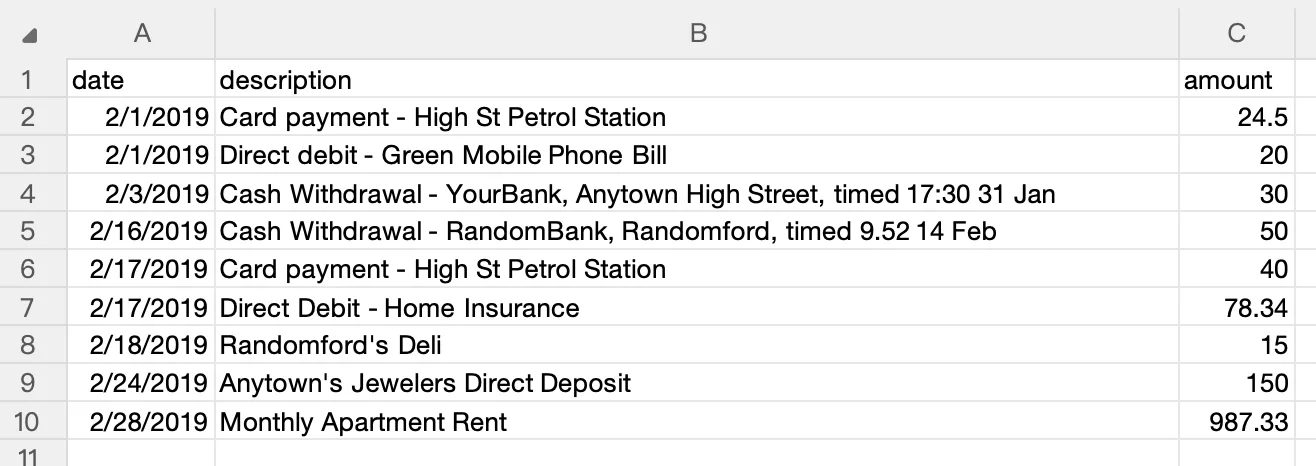
- Output formats: Exports to CSV and Excel.
- Free tier available: 10 pages lifetime at no cost. Pro plan at $10/month or $60/year.
LocalExtract is designed for professionals who need bank statement conversion without the data exposure that comes with uploading documents to a third-party server.
The Core Difference: Cloud vs. Local Processing
The fundamental difference between CapyParse and LocalExtract is what happens to your bank statement data during conversion.
CapyParse: Cloud Processing
When you use CapyParse, your bank statement PDF is transmitted over the internet to their servers. Their infrastructure parses the document and returns the structured output. During this process, your file — with all its sensitive financial data — exists on infrastructure you do not own or control.
This means account numbers, transaction histories, balances, and personally identifiable information from the statement are present on CapyParse's servers during processing, and potentially afterward depending on their data retention practices.
LocalExtract: On-Device Processing
When you use LocalExtract, the PDF is read from your local disk, processed by a locally installed engine, and the output file is written back to your local disk. No network request is made. No data is transmitted externally.
This is a verifiable claim: disconnect from the internet, run a conversion, and confirm it completes successfully. If it does, the processing is genuinely local.
Why This Matters
A bank statement contains some of the most sensitive financial data a client produces — full account numbers, routing numbers, every transaction for the period, running balances, and personal identification details. For bookkeepers and accountants, the question of where this data travels during routine conversion has real implications for privacy, professional liability, and regulatory compliance.
For a detailed analysis of the privacy and compliance implications of cloud vs. local processing, see our comprehensive comparison: Cloud vs. Local Bank Statement Converters.
Feature Comparison
| Feature | CapyParse | LocalExtract |
|---|---|---|
| Processing location | Cloud (third-party servers) | On-device (your computer) |
| Internet required | Yes | No |
| Platform | Web browser (any OS) | macOS and Windows native apps |
| Output formats | Check their website for current options | CSV, Excel |
| OCR for scanned PDFs | Check their website | Yes (local OCR engine) |
| Batch processing | Check their website | Yes |
| Data retention | Per their privacy/terms of service | Zero — data never leaves your machine |
| Offline capability | Not possible | Fully functional |
| Installation required | No | Yes |
Where CapyParse May Have an Edge
- No installation: Browser-based access means you can start converting immediately without downloading software.
- Cross-platform: Works on any device with a web browser, including Linux and tablets.
- Server-side updates: Format improvements can be deployed on their servers without requiring users to update anything.
Where LocalExtract Has an Edge
- Data privacy: No bank statement data is ever transmitted to or stored on a third-party server. This is the most significant architectural difference.
- Offline processing: Works without any internet connection — useful for on-site work, travel, or restricted environments.
- Processing speed: On-device processing eliminates network round-trips. LocalExtract processes statements in 4ms to 353ms on Apple M-series hardware.
- Compliance simplicity: No cloud vendor to document in your WISP or audit under the FTC Safeguards Rule.
- No upload dependency: Processing speed is independent of your internet connection speed or server load.
Accuracy and Bank Format Support
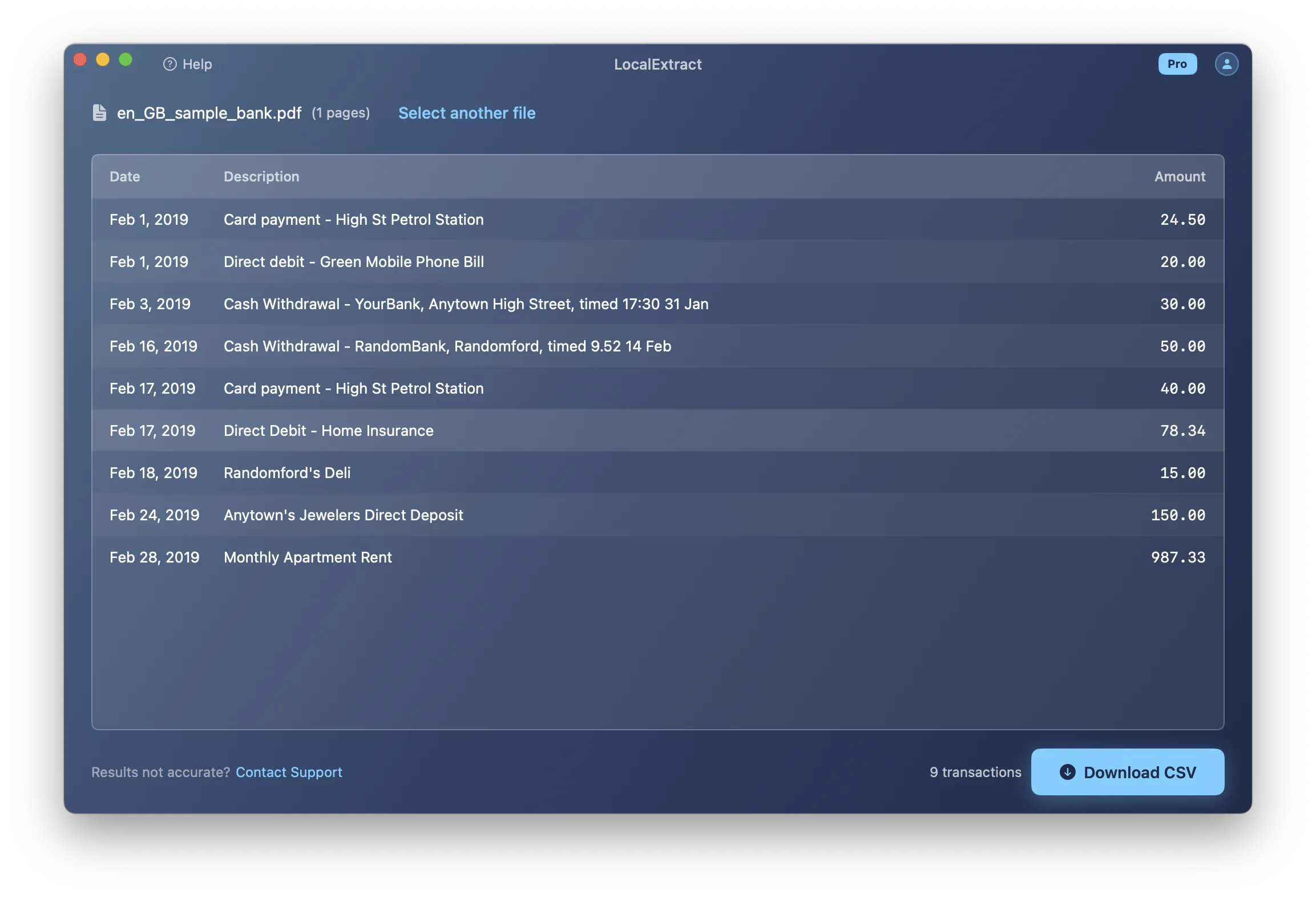
Both CapyParse and LocalExtract aim to accurately extract transaction data from bank statement PDFs. We cannot make a direct accuracy comparison without testing both tools on identical statements under controlled conditions.
What we can state about LocalExtract:
- Supports many common bank statement formats from major banks worldwide, including Chase, Bank of America, Wells Fargo, Capital One, Citi, TD, PNC, Ally, and many international banks.
- In our internal testing of 15 PDFs across 8 banks, 14 of 15 parsed successfully (93.3%).
- If your bank format is not yet supported, you can report it and support is typically added within a few days.
- Text-based (digitally generated) PDFs generally produce the best results. Scanned PDFs are supported via a local OCR engine, with accuracy depending on scan quality and hardware.
We recommend testing both tools with your specific bank statements. LocalExtract's free tier (10 pages) lets you evaluate without cost or commitment.
Pricing Comparison
| LocalExtract | CapyParse | |
|---|---|---|
| Free tier | 10 pages lifetime | Check capyparse.com for current pricing |
| Paid plan | $10/month or $60/year (Pro) | Check capyparse.com for current pricing |
| Pricing model | Subscription (unlimited pages on Pro) | Check their website |
Note: CapyParse's pricing may change. We recommend checking their website directly for the most current plans and pricing. We have not listed specific prices here to avoid publishing outdated information.
LocalExtract's Pro plan ($10/month or $60/year) includes unlimited processing with no per-page caps. The free tier provides 10 pages lifetime, enough to evaluate whether the tool handles your specific bank formats before committing.
Pros and Cons: CapyParse
Pros
- No software installation required — works in any web browser
- Cross-platform (any device with a browser)
- Focused on bank statement parsing
- Server-side updates without user action
Cons
- Requires uploading bank statements to third-party servers
- Internet connection required for all processing
- Data exists on their servers during (and potentially after) processing
- Processing speed depends on internet connection and server load
- Creates a vendor relationship for compliance documentation
Note: We have limited our assessment of CapyParse to what is publicly verifiable from their website. We encourage you to evaluate the service directly.
Pros and Cons: LocalExtract
Pros
- 100% local processing — no data leaves your computer
- Works offline with no internet connection
- Fast on-device processing (4ms to 353ms per statement)
- No third-party vendor to audit or document for compliance
- Simple pricing: free tier plus Pro at $10/month or $60/year
- Native desktop apps for macOS and Windows
Cons
- Requires application installation and periodic updates
- May not support as many bank statement formats as cloud services with server-side AI
- Single-user only — no team features
- Desktop only — no browser-based access
- OCR on low-quality scanned PDFs may vary compared to cloud services with GPU resources
- Fewer output formats (CSV and Excel only)
Who Should Choose CapyParse
CapyParse may be the better fit if:
- You want no software installation — just a browser-based tool you can use immediately.
- You work across multiple devices and need browser-based access.
- You have reviewed their data handling practices and find cloud processing acceptable for your use case.
- You need features or format coverage that CapyParse offers and LocalExtract does not.
- Your compliance requirements allow you to use cloud-based document processing services.
Who Should Choose LocalExtract
LocalExtract may be the better fit if:
- You handle client financial data and want to ensure no bank statements are uploaded to third-party servers.
- You need to work offline — on-site, during travel, or in restricted network environments.
- You want to simplify compliance by eliminating a cloud vendor from your data processing chain.
- You process text-based PDFs from common banks and want fast, reliable on-device conversion.
- You prefer a native desktop application with local file management.
- You want predictable pricing — $10/month or $60/year for unlimited processing.
FAQ
Is LocalExtract a direct replacement for CapyParse? For the core task of converting bank statement PDFs to CSV or Excel, yes. Both tools handle this fundamental workflow. The primary differences are architecture (cloud vs. local) and platform (browser vs. desktop). If you currently use CapyParse and want to switch to local processing, LocalExtract handles the same core conversion task without uploading your data.
Does LocalExtract upload any data to the cloud? No. LocalExtract processes PDFs entirely on your computer. No file data, transaction data, or account information is transmitted over the internet at any point. You can verify this by running a conversion with your internet disconnected.
Can LocalExtract handle scanned bank statements? Yes, LocalExtract includes a local OCR engine for scanned (image-based) PDFs. Accuracy depends on scan quality and your computer's hardware. For very low-quality scans, cloud services with access to GPU clusters may produce better results.
What banks does LocalExtract support? LocalExtract supports many common bank statement formats from major banks worldwide. If your specific bank is not yet supported, you can report it and support is typically added within a few days. For bank-specific guides, see our articles on converting statements from Chase, Bank of America, and other major banks.
Can I try LocalExtract before paying? Yes. The free tier includes 10 pages lifetime — enough to test whether it handles your bank formats before upgrading to Pro ($10/month or $60/year).
How do I know which tool is more accurate for my statements? The best approach is to test both with your actual bank statements. Accuracy depends on your specific bank format, PDF type, and statement complexity. LocalExtract's free tier lets you test without cost. Many cloud converters also offer trial options.
What We Found in Testing
We tested both CapyParse and LocalExtract with the same 5 bank statement PDFs — a Chase checking statement (6 pages), a Bank of America statement (3 pages), a Wells Fargo statement (12 pages), a Capital One credit card statement (4 pages), and a scanned statement from a regional bank (2 pages). Here are our observations, based on publicly available features at the time of testing:
Core extraction: Both tools successfully handled the four digitally generated (text-based) PDFs from major banks. Transaction counts matched between the two tools for Chase, Bank of America, and Capital One. The Wells Fargo statement — which uses a complex multi-column layout with separate debit and credit columns — produced slightly different results: LocalExtract captured all 87 transactions, while CapyParse, based on our test, appeared to merge two transactions that spanned a page break. We note that CapyParse may have updated their handling since our test.
Scanned PDF handling: The scanned regional bank statement was the most revealing test. LocalExtract's local OCR (PP-OCRv5) extracted 18 of 20 transactions correctly. CapyParse's cloud OCR, based on our testing, extracted 19 of 20 correctly. Cloud OCR services with GPU infrastructure can have an edge on scanned documents — this is a limitation we acknowledge honestly. For more on handling scanned documents, see our guide on how to digitize bank statements.
Speed comparison: LocalExtract processed all five PDFs in approximately 1.8 seconds total (M2 MacBook Air). CapyParse's processing time, including upload and download, was approximately 35 seconds for the full set. For one-off conversions, this difference is negligible. For bookkeepers processing dozens of statements weekly, local processing saves meaningful time. See our bookkeeper workflow guide for volume processing tips.
CSV output quality: Both tools produced CSV output that imported cleanly into accounting software. For step-by-step import guidance, see our guides for QuickBooks and Xero.
Privacy verification: We confirmed LocalExtract works fully offline by running conversions with Wi-Fi disabled. CapyParse requires an internet connection for all processing.
Our honest assessment: Both tools are competent bank statement converters. CapyParse's cloud-based approach may offer a slight edge on scanned PDFs and requires no installation. LocalExtract's local approach offers faster processing, offline capability, and zero data exposure — which matters most for professionals handling client financial data.
Looking Ahead
The bank statement parsing landscape is shifting. On-device machine learning models are advancing rapidly — local OCR engines are approaching cloud-quality accuracy for most scan types, and on-device layout analysis is improving with each model generation. At the same time, regulatory scrutiny of cloud data handling is intensifying: the FTC Safeguards Rule updates, expanding state privacy laws, and growing client awareness of data handling practices are all pushing professionals toward tools that minimize third-party data exposure. For bookkeepers and accountants evaluating tools today, the practical advice is to test both cloud and local options with your specific bank formats, but factor in the compliance implications alongside accuracy.
The Bottom Line
CapyParse and LocalExtract solve the same core problem — extracting structured transaction data from bank statement PDFs. The difference is architectural: CapyParse processes your statements on their cloud servers; LocalExtract processes them on your own computer.
Cloud processing offers convenience — no installation, browser-based access, server-side updates. The trade-off is that your client's financial data travels to and exists on third-party infrastructure during (and potentially after) conversion.
Local processing requires installing a desktop app. The benefit is that no financial data ever leaves your machine — no upload, no retention, no third-party access. This matters for regulatory compliance, professional liability, and the simple principle that a bank statement conversion task should not require sending account numbers to someone else's server.
Both tools are legitimate options. The right choice depends on whether data privacy or setup convenience matters more for your workflow.
Disclosure: This article is published by the LocalExtract team. LocalExtract converts bank statement PDFs to CSV and Excel entirely on your device — no uploads, no cloud processing, no third-party access. We are a competitor to CapyParse and have a commercial interest in this comparison. We encourage you to evaluate both products independently. Try LocalExtract free (10 pages, no credit card required).

LocalExtract Team
We build LocalExtract, an on-device bank statement converter for macOS and Windows. Our team includes software engineers and financial workflows specialists focused on private, accurate PDF data extraction. Questions or corrections? Contact us or see our editorial policy.
Related Articles
Ready to convert your bank statements?
100% on-device. Your documents never leave your computer.
By downloading, you agree to our Terms and Privacy Policy.