
Missing bank-payment evidence: ask for the unanswered facts
Updated · 4 min read
When a bank line has no invoice or clear purpose, ask for the missing fact for that event, rather than asking the client to guess an accounting category. Keep invoice evidence, business purpose and the source of an incoming credit as separate questions. Receiving one attachment does not resolve every question.
The desktop apps export date, description, and amount as CSV. Open CSV in Excel to save an XLSX workbook. Statement support varies: verify the result against your own PDF.
Build a question register tied to bank events
For the bookkeeper preparing a review, an event ID identifies one bank movement; a question ID identifies one missing fact. A response can support one question while leaving another open. This register is an author-designed workflow, not a required government form.
- Preserve the bank event and create a request ID. Include only the minimum useful date, amount, currency and reference; keep the original account context in the controlled review record.
- State the missing fact precisely: supplier invoice, business purpose, or source/explanation of an incoming credit. Do not supply an assumed expense, revenue, loan or owner-funding classification.
- Request the relevant supporting document and explanation. Separate two questions on the same movement so an invoice can arrive without silently answering the purpose question.
- Record requested, received, reviewed and resolved as distinct states. Link the response to the question it actually addresses; retain reviewer ownership and outstanding facts.
- Hand unresolved questions to the authorized reviewer. Preparing wording is different from sending it, and neither a response nor a bank amount alone establishes tax validity or completed reconciliation.
The IRS supporting-record guidance describes combinations of records supporting payee, amount, payment, date and purpose. That is US context. UK company records and VAT records have their own scope. These sources do not create a worldwide invoice checklist, retention period or deduction rule.
Use questions that do not pre-classify the answer
For a payment with no invoice, a draft question can read: “For bank event B1, please provide the supplier invoice or other supporting document and identify which payment it relates to.” If purpose is also missing, keep a separate question: “What business activity or project does B1 concern, and what record supports that explanation?” Avoid treating a filename or merchant label as the answer.
For an unexplained incoming credit: “Who sent bank event B2, what does it relate to, and which document supports that explanation?” Do not call the credit sales income before the response and evidence support that conclusion. A bank trace can identify a sender without resolving the economic purpose.
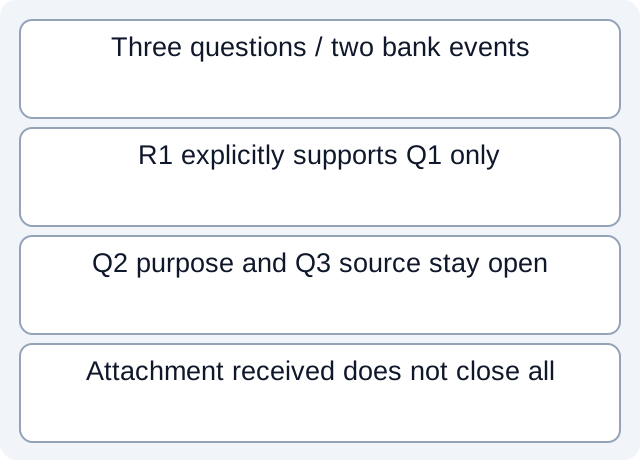
Our fictional register has Q1 for B1’s invoice, Q2 for B1’s purpose and Q3 for B2’s credit source. Response R1 is explicitly reviewed as addressing Q1 in the scenario. Q2 and Q3 remain open. The result is two unanswered questions, not two missing bank transactions and not a declaration that the invoice meets any tax requirements.
| Fictional question | Event | Evidence received | Remaining decision |
|---|---|---|---|
| Q1: supplier invoice | B1 | R1, reviewed for this request only | Document request addressed in the scenario |
| Q2: business purpose | B1 | None | Purpose remains unknown |
| Q3: incoming-credit source | B2 | None | Do not classify the credit yet |
Inspect the fictional questions, response links and executed open-question check. The script reads the given question/response identities; it does not assess document authenticity, tax validity, client behavior or the effectiveness of a message. No real communication was sent.
Close only the fact that was supported
A received invoice may still leave business purpose, payment allocation or source identity unresolved. If a response refers to another date or currency, retain that mismatch instead of moving it to the expected bank line. If several bank events concern one document, record the supported allocation separately rather than repeating the document amount as new cash.
Limit the request to relevant information and use the organization’s approved channel. Unrelated account numbers, other customers’ transactions and personal documents need not be copied into a broad query list. Do not request passwords, security codes or access tokens. A lack of evidence is a review issue, not permission to invent a classification or accuse a client of wrongdoing.
This shared workflow covers missing invoices, unclear payment purpose and unexplained receipts in one register. For the earlier collection/handoff stage, see the bookkeeper’s statement workflow; for supplier totals after identity is supported, use supplier payments and refunds.
If a bank source is only PDF, download LocalExtract to extract one PDF locally into date,description,amount CSV. Check the source rows; the app does not obtain invoices, contact clients or classify the transaction for you.
Official sources checked October 17, 2026; jurisdiction examples remain separate from this general preparation method.
LocalExtract Team
We build LocalExtract, a desktop bank statement converter. Questions or corrections? Contact · Editorial policy