
Cash forecast: avoid counting a paid invoice twice
Updated · 4 min read
Do not put a receipt already included in the bank balance into future cash inflow again. Build a cash-planning worksheet from one fixed bank cutoff, then add only remaining expected collections and outflows with stated timing assumptions. An invoice due date is not proof of a bank arrival date.
The desktop apps export date, description, and amount as CSV. Open CSV in Excel to save an XLSX workbook. Statement support varies: verify the result against your own PDF.
Separate actual cash from future expectations
Here, actuals are historical bank observations up to the cutoff. Expected rows are planning assumptions for later periods. Opening cash is the supported balance at that boundary, not a new inflow to add on top of all historical transactions.
- Fix the account scope, currency, cutoff and source version. Preserve the opening cash evidence and historical receipt identities.
- For each unpaid invoice, record the original amount, separately supported receipts and remaining amount. Keep invoice identity evidence; a similar bank description is not an automatic match.
- Give the remaining amount an expected collection period only when a supported or explicitly assumed timing basis exists. Leave unknown timing unallocated and visible.
- Keep expected outflows separate from actual payments and label their date/amount assumptions. Do not pool currencies without a documented conversion method.
- Calculate opening cash plus expected incoming less expected outgoing for each scenario. Retain an alternative without uncertain collection and explain which assumption changed.
Australian cash-flow guidance distinguishes actual figures and estimates and provides the opening/incoming/outgoing/closing relationship. Its Australian GST discussion is not a global tax rule. This article uses that arithmetic for a planning worksheet, not a statutory statement or a guarantee of funds.
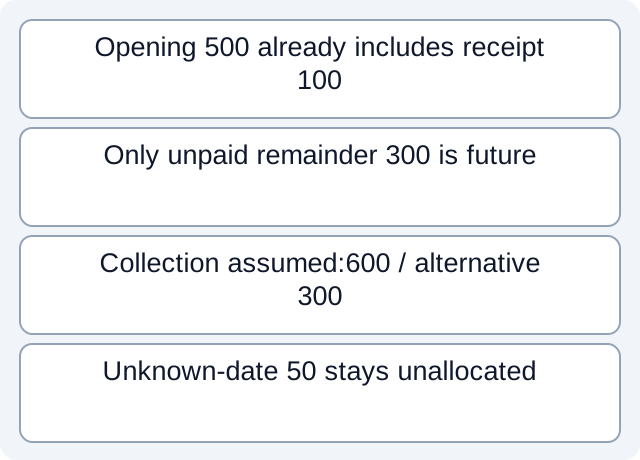
Read the unpaid amount before placing it in a period
In the fictional EUR case, opening bank cash is 500 and already includes historical receipt H1=100. Invoice I1 originally totals 400 and is explicitly associated with H1, leaving 300 unpaid. The scenario assumes the remaining 300 will arrive in November and expects an outflow 200 in that month.
The collection scenario closes at 600: 500+300−200. The alternative without that uncertain collection closes at 300: 500−200. Adding H1 again would double count an amount already included in opening cash. Neither result predicts what the bank will actually show.
Another unpaid invoice I2=50 has no collection date. Keep it as an unallocated expectation, rather than inserting it into November or replacing its unknown date with a due date. The worksheet may report the 50 outstanding without treating it as a confirmed November receipt.
| Fictional item | EUR | Planning treatment |
|---|---|---|
| Opening bank cash including H1 | 500, includes 100 | Fixed cutoff balance |
| I1 original / observed receipt / remaining | 400 / 100 / 300 | Only remaining 300 considered for future cash |
| Assumed November collection / outflow | 300 / 200 | Collection scenario closes 600 |
| Alternative without collection | 0 incoming / 200 outgoing | Closes 300; assumption differs |
| I2 without collection date | 50 | Unallocated, not a certain November inflow |
The fictional actual/expected register and executed scenario arithmetic read the given rows and compute these finite results. They do not infer collection dates, connect to invoices, run Excel or measure forecasting accuracy.
Use spreadsheet totals without hiding uncertainty
Microsoft’s SUMIFS documentation describes summing rows with multiple criteria. It does not validate supplier/customer identity, receipt membership or whether an expected date is realistic. A formula can correctly total badly classified rows.
If using a spreadsheet, separate actual/expected status, currency and scenario/period fields before totaling. Keep the source IDs and date basis beside the number so the reviewer can trace a changed assumption. Blank dates belong on the exception list, rather than silently disappearing into a reassuring total.
When new cash evidence arrives, retain the prior scenario and mark the receipt as actual at the next cutoff. Recalculate the remaining invoice from supported observations instead of leaving its earlier forecast amount alongside the new bank receipt. The reviewer can then see a changed expectation without counting the same cash twice.
For historical comparison, see bank reconciliation. If the historical bank source is only PDF, download LocalExtract to extract one PDF locally into date,description,amount CSV. Check the extracted rows; the app does not forecast cash, classify invoices or guarantee collection.
Official documentation checked October 17, 2026. This is an evidence-organizing planning example, not individual financial or tax advice.
LocalExtract Team
We build LocalExtract, a desktop bank statement converter. Questions or corrections? Contact · Editorial policy