
Loan bank debit: verify the lender’s actual payment allocation
Updated · 4 min read
A bank loan debit alone does not tell you how much the lender applied to principal, interest or escrow. Obtain the actual payment-application history, rather than splitting the bank amount from the current amount due. Keep an unsupported component unknown even if a subtraction produces a convenient number.
The desktop apps export date, description, and amount as CSV. Open CSV in Excel to save an XLSX workbook. Statement support varies: verify the result against your own PDF.
Collect the applied history, not just the payment schedule
This guide prepares evidence for a reviewer; it does not calculate an amortization schedule or decide tax treatment. Principal is the lender-applied reduction of loan balance, interest is a separately applied charge, and escrow is money the servicer records for relevant third-party payments. Their actual amounts must come from the applicable lender record.
- Preserve the bank event’s posted date, amount, currency and available reference. Keep the complete statement period and account context.
- Ask the authorized owner for the corresponding servicer statement and payment-application record. Record their versions, period and source identity; this guide has not verified a particular lender’s portal menu.
- Separate the statement’s current amount due from past payment history. Locate the specific applied payment and its supplied principal, interest, escrow, fee or unapplied components.
- Compare those supported components with the relevant bank event. Record missing components and unexplained differences without assigning a balancing amount to principal or interest.
- Hand the reviewer the bank reference, lender application evidence, any unapplied-payment information and the unresolved question. A date or amount match alone is not permission to post an allocation.
The CFPB’s US mortgage-servicer guidance distinguishes the amount due from payment history and transaction activity. Its statement requirements have exceptions, including relevant coupon-book and small-servicer situations. Do not extend this US mortgage guidance to every loan, country or statement entitlement.
Compare complete and incomplete evidence differently
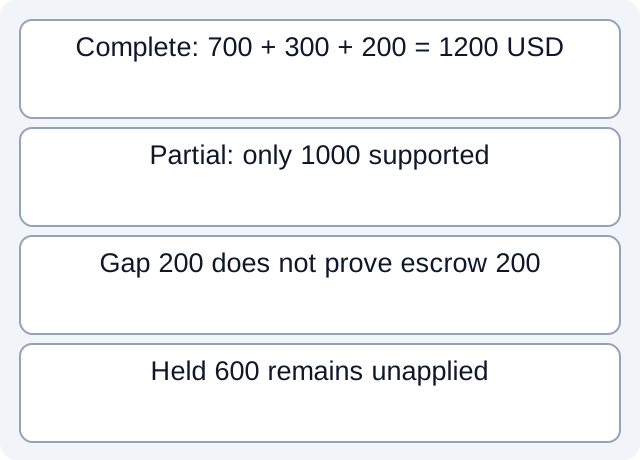
Our fictional CSV contains three separate teaching situations. In the complete situation, bank debit 1,200 USD has a supplied application of principal 700, interest 300 and escrow 200. The components sum to 1,200 because all three were provided by the scenario, not inferred from a rate.
In the partial-evidence situation, the bank debit is also 1,200, but the lender information supplied supports only principal 700 and interest 300. The difference is 200, while escrow is blank. That subtraction does not prove escrow 200; it identifies a missing explanation to request. The two situations must not be combined as if one complete record fills the other’s blank.
The third situation gives a 600 debit and a servicer record explicitly calling 600 unapplied. No principal or interest allocation is supplied. The CFPB explains that partial payments can be held until enough exists for a full payment. The debit therefore cannot by itself establish that the loan balance was reduced.
| Fictional situation | Bank USD | Supplied application | Review result |
|---|---|---|---|
| Complete | 1,200 | 700 principal + 300 interest + 200 escrow | Components cover the supplied debit |
| Partial evidence | 1,200 | 700 principal + 300 interest; escrow unknown | 200 unexplained, not inferred escrow |
| Held partial payment | 600 | 600 explicitly unapplied | No supported principal/interest split |
Read the fictional lender-application CSV and executed comparisons. The local checks read those constructed rows and compare supplied amounts. They do not reproduce a servicer’s allocation rules, calculate interest, validate a lender export or observe a real payment.
Handoff the unanswered question without changing the evidence
If bank and lender dates differ, preserve both and the statement cutoffs. Ask which payment the servicer applied and whether any amount remains unapplied. If a fee or escrow change is asserted, request the actual supporting entry rather than treating it as a balancing category.
The IRS recordkeeping explanation notes that supporting records can require a combination of documents. Here that supports retaining payment and purpose evidence; it is not a loan-allocation algorithm or a decision on deductibility. Leave journal classification and any legal/tax question with the authorized reviewer.
For the broader balance-and-exception process, see bank statement reconciliation. If the bank provides only PDF, download LocalExtract to extract one PDF locally into date,description,amount CSV. Verify the rows against the issued statement; the app does not retrieve lender allocations or split principal and interest automatically.
Official sources checked October 17, 2026. General evidence-preparation method; the cited mortgage-statement rules remain US-only.
LocalExtract Team
We build LocalExtract, a desktop bank statement converter. Questions or corrections? Contact · Editorial policy