
Airbnb UK: whose payout records explain the bank credit?
Updated · 3 min read
An Airbnb UK host’s bank credit does not prove a co-host received their share. Identify whose payout record and destination observation you are examining, then expand the components of that particular payout. Recipient visibility and payout composition answer different questions.
The desktop apps export date, description, and amount as CSV. Open CSV in Excel to save an XLSX workbook. Statement support varies: verify the result against your own PDF.
Identify the recipient before requesting the report
The co-host payout guidance says the listing owner cannot see a co-host’s transaction history. Earnings access does not grant access to everyone’s payout methods or taxpayer details. Obtain each person’s minimum necessary supporting record through an authorized channel; do not share credentials or change permissions to investigate a bank credit.
For the documented host desktop route:
- Open Today → Menu → Earnings and choose Paid or Upcoming.
- Apply the appropriate listing, payout-method and date filters.
- For a CSV, use Get report → Open on your device or Email your report, select fields and Create report, following the download instructions.
- In Paid, expand the identified payout row and retain its reservation/adjustment composition. The earnings guide explains that some reservations at multiple listings starting on the same day can be paid together.
- Keep the recipient’s actual destination receipt as separate evidence. A Paid/sent record does not by itself establish a bank credit.
Check program limits before assuming a co-host split
Airbnb documents that co-host payouts are not supported for Residential Hosting in the UK and Canada. Do not turn an ordinary home-stay example into a promise for that program. Shared co-host payouts concern guest stays; they do not encompass Services, Experiences, damage-protection or Resolution Center payouts. Confirm the actual program and payment type before interpreting a missing share.
A host composition does not establish another recipient’s receipt
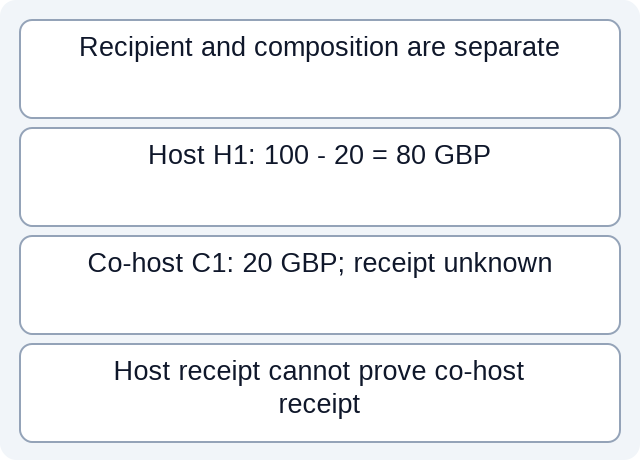
Our fictional CSV gives Host-A reservation 100 GBP and an explicitly given adjustment−20 in payout H1, producing 80. It separately lists Co-host-B’s20 under C1 with no destination receipt. We read and grouped the rows by recipient, rather than allocating the host bank amount equally across people or listings.
| Fictional object | GBP | What is actually supported |
|---|---|---|
| H1 reservation | 100 | Component stipulated for Host-A |
| H1 adjustment | −20 | Separate, explicitly given component |
| H1 total | 80 | Only the host’s receipt is stipulated |
| C1, Co-host-B | 20 | Bank receipt remains unknown |
The adjustment is not automatically a fee on the current reservation. Airbnb’s extra-payout recovery guidance describes deductions that can span later payouts; it does not diagnose every negative adjustment as that recovery incident. Keep the actual adjustment evidence before assigning a cause.
Leave two kinds of gap visible
A composition gap asks which reservations/adjustments belong to the identified payout. A recipient gap asks which authorized destination actually received it. Missing evidence in either remains open, even if the arithmetic balances. No payout method, split or permission should be changed just to make a reconciliation screen appear complete.
Download the fictional recipient/composition file and executed recipient totals. These are author-defined teaching relationships, not Airbnb’s export schema or a tested UK booking/payout.
For PDF-only bank evidence, LocalExtract prepares a local CSV from one PDF with date,description,amount. Review those rows against the issued bank record; LocalExtract does not access Airbnb or synchronize payout records. The bank reconciliation guide covers the shared statement-to-ledger method.
Official documentation checked October 17, 2026.
LocalExtract Team
We build LocalExtract, a desktop bank statement converter. Questions or corrections? Contact · Editorial policy