
Zoho Books foreign-currency payment residual: which evidence to collect?
Updated · 3 min read
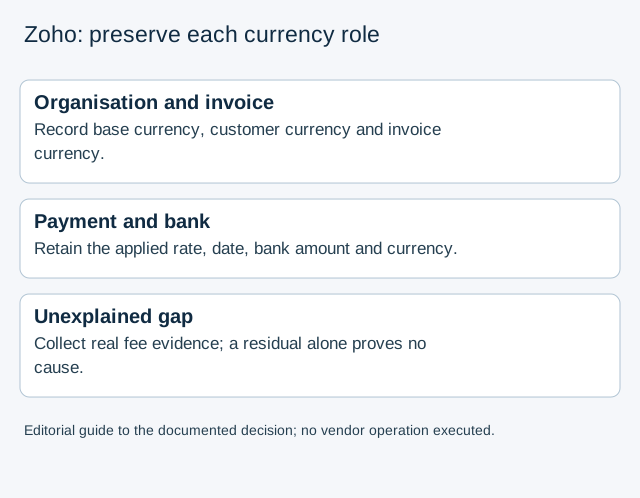
For a Zoho Books US-EN reviewer investigating a residual after a foreign-currency bank payment, collect the invoice, customer, organisation and bank currencies before assigning a cause. A leftover amount does not establish a bank fee or an exchange-rate error. This guide prepares evidence; it does not change a posted payment or resolve a real account's residual.
The desktop apps export date, description, and amount as CSV. Open CSV in Excel to save an XLSX workbook. Statement support varies: verify the result against your own PDF.
Identify the three currency roles
Zoho's currency settings guide describes Settings → Organization Settings → Setup & Configurations → Currencies. Read the currency tagged Base Currency; do not infer it solely from the bank account or a customer's invoice.
| Record | Evidence to preserve |
|---|---|
| Organisation | Actual edition/plan and tagged base currency |
| Customer and invoice | Customer currency, invoice currency, invoice amount and date |
| Existing recorded payment | Amount, currency, payment date and applied rate/source |
| Bank movement | Bank-account currency, credit amount/date and separate charge evidence |
A base-currency invoice paid into a foreign-currency bank account is not automatically the same case as an invoice in a third currency. Zoho's foreign-payment FAQ describes a customer currency different from both base and bank currency, using an Undeposited Funds workaround. Do not apply that route to an already posted residual merely because all three records mention currency.
Preserve the applied rate and its date
The currency guide identifies Open Exchange Rates feeds and manually entered rates with effective dates. A manual rate applies within its documented date range. Deleting a manual rate does not change the rate already applied to past transactions.
Record the rate on the existing payment, its direction and its source. Today's settings or today's market rate are not proof of what an earlier transaction used. Do not delete a rate, recreate the payment or enter an adjustment merely to see whether the displayed residual disappears.
A small arithmetic example cannot identify the cause
Suppose a fictional USD invoice is 100 USD and the bank credit is 90 EUR. Under the exercise's expressly stipulated rate of 1.10 USD per EUR, that credit equals 99 USD. The arithmetic gap is 1 USD; it is not evidence that the bank charged 1 USD or that 1.10 was the real payment's applied rate.
The finite currency evidence case performs that Decimal multiplication and subtraction while keeping the actual rate, fee and residual cause unverified. It is not a Zoho posting, a suggested journal adjustment or a general currency-matching algorithm.
Obtain charge evidence separately
Zoho's bank-charge FAQ describes explicit charge entry on invoice payments and a manual bank-category route. The existence of that field does not make every unexplained difference a charge. Preserve an actual bank fee record or payment-provider breakdown and establish whether it is separately posted or included in the net credit before asking for an authorized correction.
Finish with the four original records, applied-rate evidence, fee evidence and the exact remaining question. If payer, rate or charge is unknown, retain that unknown rather than forcing agreement. The existing Zoho unmatch/uncategorize guide covers a separate correction-object decision; it is not a shortcut for diagnosing currency.
For a PDF-only bank source, LocalExtract prepares local CSV, one PDF at a time with date,description,amount. It does not export applied Zoho rates, classify a fee or synchronize accounting entries.
Official US-EN Zoho help checked October 17, 2026. Other regional editions and a particular organisation's entitlements require their own checks.
LocalExtract Team
We build LocalExtract, a desktop bank statement converter. Questions or corrections? Contact · Editorial policy