
Tyro Australia: daily sales, settlement and monthly fee evidence
Updated · 4 min read
If an Australian merchant’s Tyro daily sales and bank credit differ, first check which facilities Tyro actually settles and which business day the report covers. Then compare the separate invoice and bank evidence. An unexplained daily difference is not proof that Tyro deducted that amount as a fee.
When the source bank statement is PDF-only, LocalExtract can prepare a local CSV comparison copy. Keep the original statement, Tyro report and invoice: extracted transaction rows do not establish their relationship by themselves.
The desktop apps export date, description, and amount as CSV. Open CSV in Excel to save an XLSX workbook. Statement support varies: verify the result against your own PDF.
Select the Tyro-settled population and day
Tyro’s current Portal reporting guide describes Reports → Reconciliation summary for Tyro-settled EFTPOS/ecommerce facilities over a maximum 31-day interval. Its total can cover several days. Reconciliation daily gives separate daily totals in the same Tyro-settled scope and downloads as CSV only; summary also offers Excel and Print-to-PDF.
The EFTPOS machine report separately distinguishes Settled by Tyro and Not settled by Tyro, including Alipay/American Express in the latter category described by the guide. A terminal sales total can therefore contain a population that a Tyro-settled reconciliation total does not.
- Record the merchant/facility identities, report type, selected interval and whether the total is daily or interval-wide.
- Inspect the included facilities and underlying transactions. Do not assign a non-Tyro-settled scheme to a Tyro payout merely because it occurred on the same terminal.
- Read the terminal’s existing settlement-day configuration and the actual report cutoff. Tyro’s manual-settlement documentation describes settlement-day behaviour; schedules can differ. Do not assume midnight or change the terminal to make a comparison fit.
- Compare the issued bank credit using evidence of the corresponding settlement. A shared date or amount is a candidate clue, not a unique identifier.
For transaction details, the reporting guide distinguishes one TID with no more than 31 days from larger selections saved to Recent Reports. Keep the actual exported selection; a report’s presence does not establish every facility or settlement day was requested.
Test membership before interpreting the difference
In this fictional AU exercise, the source explicitly supplies the settlement provider and day membership of each sale. These are author-defined teaching fields, not a native Tyro CSV schema.
| Given transaction | AmountAUD | Supplied settlement scope |
|---|---|---|
| T1 | 100.00 | Tyro, business dayD1 |
| T2 | 50.00 | Tyro, business dayD1 |
| T3 | 30.00 | Other provider, business dayD1 |
| T4 | 20.00 | Tyro, business dayD2 |
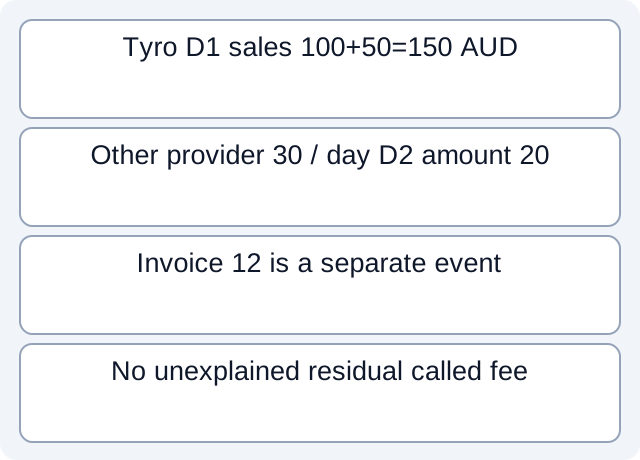
The supplied Tyro D1 population is 150.00 AUD. Adding every row gives 200.00 AUD, but the extra 50.00 AUD combines a different provider and a different business day. It is not a fee calculation. An independently supplied bank record B1 is explicitly linked to the D1 settlement and credits 150.00 AUD; that link is a premise of the exercise, not an automated match based on the sum.
If the bank credit were 148.00 AUD without further evidence, the 2.00 AUD residual would remain unexplained. It could not be labelled a fee from this table. Likewise, if B1’s relationship were not supplied, its 150.00 AUD amount alone would not prove that it settles T1 and T2.
The fictional worksheet and finite results preserve the supplied premises and calculations; they are not vendor exports or a reusable account-verification tool.
Inspect the monthly invoice on its own billing basis
For costs, Tyro’s monthly-invoice instructions describe Costs → Invoices → year/month → View your invoice. Administrator access is required. The PDF identifies invoice date, billing period and cost components; the billing period is not necessarily a calendar month.
The documented invoice can include transaction costs, device/service fees, accessories, adjustments and surcharge credits. Multiple MIDs can have different invoice dates and separate debits. The invoice page also displays the expected debit information. Those facts make a presumed fixed daily deduction particularly unreliable.
Keep an invoice register with its own period, MID, total and nominated fee-account debit evidence. In a second fictional observation, invoice I1 totals 12.00 AUD and a separately supplied bank debit B2 is explicitly linked to it. That supports the supplied invoice/debit relationship. Subtracting 12.00 AUD from D1’s 150.00 AUD settlement would mix distinct events and produce a fictitious 138.00 AUD payout.
A useful unresolved finding identifies the missing layer: facility/day membership, settlement-to-bank relationship, invoice component or invoice debit. Avoid a balancing adjustment that hides which evidence is absent. Continue the bookkeeping comparison through the reconciliation guide once those scopes are established.
LocalExtract processes one PDF at a time locally into date,description,amount. It does not retrieve Tyro reports, operate terminals or synchronise a merchant ledger. Download LocalExtract for a PDF bank source.
Official Tyro reporting, invoice and settlement documentation checked on October 17, 2026. The numerical examples are fictional and do not establish a real merchant’s tariff, receipt timing or PDF compatibility.
LocalExtract Team
We build LocalExtract, a desktop bank statement converter. Questions or corrections? Contact · Editorial policy