
Xero transfer matched on one side: inspect the other account
Updated · 4 min read
If a Xero transfer is reconciled in one bank account, inspect the other account’s bank statement and reconciliation state before recording anything else. Xero can create the corresponding accounting transaction from the first side; that counterpart does not prove the destination statement line has arrived or been reconciled. Creating another transfer to fill a missing statement observation risks duplicating the books.
When the bank evidence is PDF-only, LocalExtract can prepare a local comparison CSV. Retain each issued bank document: a three-field extraction cannot prove that Xero has imported or reconciled its movements.
The desktop apps export date, description, and amount as CSV. Open CSV in Excel to save an XLSX workbook. Statement support varies: verify the result against your own PDF.
Identify the transfer and both account views
Xero’s transfer guide offers creating a transfer before reconciliation or during reconciliation. These are alternatives for one transfer. Xero says to create it in one account, because the corresponding transaction is created in the other; creating a Xero transfer does not move money in online banking.
For an existing item, collect the evidence without creating another:
- Open Accounting → Bank accounts and identify the From and To accounts. Keep currency and account identity with each side, rather than searching only for an equal amount.
- Inspect the existing transfer’s date, reference and From/To details. Record what the books already represent before interpreting a missing bank-feed item.
- Inspect both accounts’ Reconcile and Bank Statements views. Xero’s statement-line guidance distinguishes bank statement observations from account transactions, and records statement Source and Status.
- Open a reconciled statement line to inspect its linked account transaction. Record an unmatched or absent statement side separately; neither status calls for a second transfer automatically.
The documented transfer-creation role is administrator or standard + bank accounts. A public help page does not establish the current user’s organisation permissions. Ask an already authorised bookkeeper for the necessary existing evidence when access is unavailable; do not expand your own permissions as a troubleshooting step.
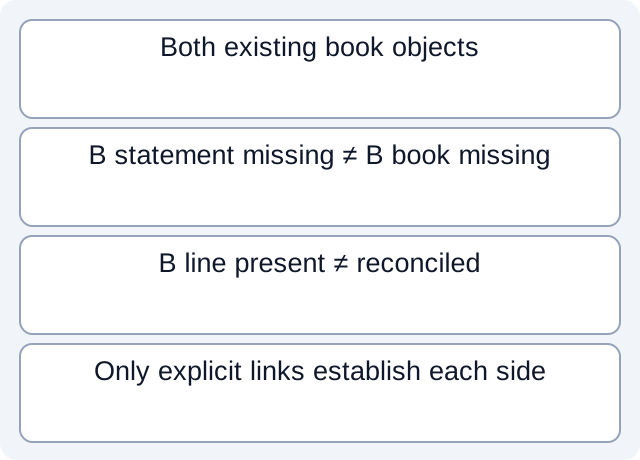
Use a two-sided evidence table
In this fictional same-currency exercise, the issuer explicitly identifies transfer T1 from account A to account B for 100.00 USD. The book entries and observations below are also supplied as facts; their shared teaching ID is not a claim that every bank export carries a Xero transfer identifier.
| Side | Existing book object | Imported statement observation | Reconciliation evidence |
|---|---|---|---|
| A / outgoing 100 USD | T1-A exists | S1 explicitly represents this debit | S1 is linked to T1-A |
| B / incoming 100 USD | T1-B exists | None in the supplied population | No statement-side match established |
Only the destination statement observation is missing in this defined population. The destination accounting object already exists. Entering a second 100.00 USD transfer would not establish a bank receipt and would introduce another accounting object.
Now consider a separate supplied state: S2 explicitly represents the B credit, but its status is Unreconciled. That is a different task from importing a missing bank line. Inspect the existing T1-B counterpart and the proposed match using Xero’s reconciliation guidance; do not assume that the appearance of S2 means somebody has already completed the match.
Finally, suppose both S1 and S2 are supplied and explicitly linked to their respective counterparts. That supports completion for this identified transfer, not a conclusion that all bank movements or the entire month are reconciled. A second equal-value payment without the supplied identities remains outside the exercise.
The fictional worksheet and finite results preserve the supplied premises and calculations; they are not vendor exports or a reusable account-verification tool.
Separate missing source, unmatched source and foreign-currency questions
When a destination line is absent, first compare the issued bank evidence with Xero’s statement history for the correct account and period. The statement-balance diagnostic explains missing, duplicate, Deleted and User-created lines. A source labelled User can arise from a manual reconciliation; it is not interchangeable with evidence that the bank feed delivered the movement.
When the line exists but is unmatched, the question is which existing object it should match. The official transfer guide describes reconciling the corresponding side after the first side, rather than creating a second transfer. Review any earlier match before an authorised correction; matching solely by amount can select an unrelated event.
For a cross-currency transfer, keep the actual amounts and currencies on both bank sides. Xero documents calculating the rate from amounts entered and different fee options for quick versus detailed transfers. A difference between currencies cannot be treated as a missing same-currency statement line, and a residual does not prove a bank fee. This article’s same-currency case establishes neither a real conversion rate nor a fee posting.
A useful handover therefore says “B’s statement line is absent,” “B’s line exists but is unreconciled,” or “B’s line is linked to T1-B,” together with the observed account and period. “Transfer unfinished” alone leaves the next person unable to distinguish three different actions.
LocalExtract processes one PDF locally into date,description,amount. It does not read Xero’s objects, create transfers or reconcile accounts. Download LocalExtract when the source statement is a PDF.
Official Xero guidance checked on October 17, 2026. The supplied-state exercise is not a Xero ledger operation, bank import or confirmation of a real transfer receipt.
LocalExtract Team
We build LocalExtract, a desktop bank statement converter. Questions or corrections? Contact · Editorial policy