
Xero foreign-bank payment: rate evidence or bank fee?
Updated · 4 min read
When a foreign-currency bank payment concerns a base-currency bill in Xero, identify the currency branch before explaining the difference. Keep the rate source and any bank-fee evidence separate. An exchange-rate report or a residual amount alone cannot prove that a fee was charged.
For a PDF bank source, LocalExtract can prepare local comparison rows. The original statement and bill remain necessary evidence; date,description,amount does not carry a verified exchange-rate source or fee classification.
The desktop apps export date, description, and amount as CSV. Open CSV in Excel to save an XLSX workbook. Statement support varies: verify the result against your own PDF.
Establish the actual currency branch
Xero’s foreign-currency reconciliation guide distinguishes base-currency and foreign-currency bank accounts, and the currencies of invoices/bills. This article concerns a foreign bank account against a bill in the organisation’s base currency. It does not substitute the clearing-account instructions for two different non-base currencies.
- Read the organisation’s base currency, the selected bank account’s currency and the existing bill’s currency. Record all three rather than describing the payment merely as “foreign.”
- In
Accounting → Bank accounts → Reconcile → Find & Match, the documented branch clears the currency-only checkbox to expose the base-currency bill. Inspect the existing candidate and its identity; this is not an instruction to confirm a match from amount alone. - Compare the actual bank movement with the bill/payment evidence and the rate information. Keep a missing fee source as unknown rather than changing a rate to absorb it.
- If your organisation lacks the needed multicurrency access or the branch differs, stop and confirm the applicable configuration with an authorised bookkeeper. A help article does not establish a current plan or regional entitlement.
Xero documents Adjustments → Bank fee when an actual foreign-exchange bank fee is included in the payment. That conditional option is not evidence that a particular difference is a fee. Do not create an adjustment as a diagnostic experiment.
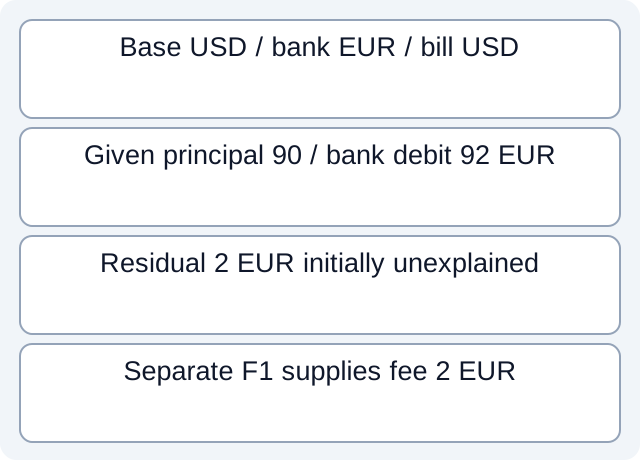
Keep rate provenance separate from bank charges
The Foreign Currency Gains and Losses report is reached through Reporting → All reports → Foreign Currency Gains and Losses → date range → Update when multicurrency is available. Its sections distinguish receivables, payables and bank accounts, with realised/unrealised measures and currency balances.
Read the relevant footnotes: they identify converted figures, rates and whether the rate originated from XE or user entry. A rate footnote concerns a valuation basis. It is not a bank fee voucher, nor proof that the selected bill is the correct counterpart of a bank debit.
In this fictional example, the organisation base is USD, the bank account is EUR and the bill is 100.00 USD. The payment evidence explicitly supplies a principal conversion of 90.00 EUR. The bank debit is 92.00 EUR.
| Supplied evidence | Established fact | Still not established |
|---|---|---|
| Bill B1 | 100.00 USD obligation | Bank fee |
| Conversion evidenceC1 | Principal 90.00 EUR for this payment | Additional debit cause |
| Bank observation S1 | Debit 92.00 EUR | Why 2.00 EUR is additional |
| Separate fee voucher F1, only in a second state | Explicit 2.00 EUR charge linked to S1 | A general tariff or other payments |
Before F1 is supplied, 92.00−90.00=2.00 EUR is an unexplained residual. After the separately stipulated voucher, this one example has evidence of a 2.00 EUR fee. The division 100.00 USD/90.00 EUR yields an implied principal ratio, but does not establish an actual XE rate, the bank’s pricing policy or Xero’s configured rate.
The report’s converted value can differ again because its valuation date or rate source is different. Preserve that basis in a separate column; do not merge every difference into one “FX loss” value or add unlike currencies together.
The fictional worksheet and finite results preserve the supplied premises and calculations; they are not vendor exports or a reusable account-verification tool.
Hand over an evidence question instead of a balancing entry
A useful unresolved note says “bill identity confirmed; EUR bank principal evidence present; additional 2.00 EUR debit lacks a fee voucher,” with the relevant references. If the principal conversion itself is unknown, say so: the fee calculation cannot be completed by choosing a convenient rate.
Keep this task separate from Xero statement-balance diagnosis, which asks whether the statement population is complete. A missing statement line and a rate-provenance question are different problems. Matching book and bank totals does not resolve either automatically.
For two different non-base currencies, return to the official branch-specific guidance rather than transplanting this bill example. Creating a clearing account, changing rates or posting fees requires the appropriate accounting decision; this read-only comparison establishes none of those outcomes.
LocalExtract processes one PDF locally into CSV. It does not select Xero matches, determine exchange rates or post fees. Download LocalExtract for a PDF source.
Official Xero documentation checked on October 17, 2026. The supplied numbers and fee voucher are fictional, not a ledger test, current plan check or validation of a real FX treatment.
LocalExtract Team
We build LocalExtract, a desktop bank statement converter. Questions or corrections? Contact · Editorial policy