
CommBank Statements to Excel: Native CSV, Interface Versions and PDF Checks
Updated · 8 min read
Prefer a suitable native CSV, check its actual coverage and use a checked PDF-to-CSV route only when needed before Excel. This guide covers the Australia product and the task described below.
The desktop apps export date, description, and amount as CSV. Open CSV in Excel to save an XLSX workbook. Statement support varies: verify the result against your own PDF.
Choose the NetBank instructions matching your interface
The new NetBank page describes rollout from late August 2026. The other NetBank support page explicitly asks users to compare their interface with its illustration. Do not combine labels from both versions into one supposed universal menu. The support page distinguishes up to seven years of statements, two years of transaction details and custom summaries.
The feature changes page confirms native transaction CSV remains in new NetBank while OFX/QIF are removed there. It does not establish exact current CSV-export controls, range or headers. A bank's ability to download multiple documents is not evidence that LocalExtract processes a batch.
Inspect native CSV before choosing PDF conversion
If new NetBank offers a CSV covering your required account, dates and detail, preserve that raw export and import a working copy into Excel. CSV is a text table, not a direct XLSX workbook. The feature page confirms the format, but a universal current Export-button sequence or complete history range was not established; use the actual controls and inspect the file offered. Do not follow an old OFX/QIF tutorial for the new interface.
In an invented comparison, a two-year activity file cannot reconstruct a three-year statement collection. A CSV containing a filtered subset can be useful for the selected question without supplying the full issued cycle. Record both the export selection and any PDF original used. When the PDF is the relevant received source, follow the complete file-to-CSV workflow below. Do not assume that choosing another NetBank version validates the PDF's exact extraction format.
| Choice | Working result | Limit |
|---|---|---|
| Suitable offered CSV | Import the actual fields | Inspect range and selection |
| Old OFX/QIF instructions | Do not apply to new NetBank | Formats removed there |
| Complete issued PDF already received | Create a separate checked CSV | No bank compatibility test here |
Create a CSV from a PDF you have actually obtained
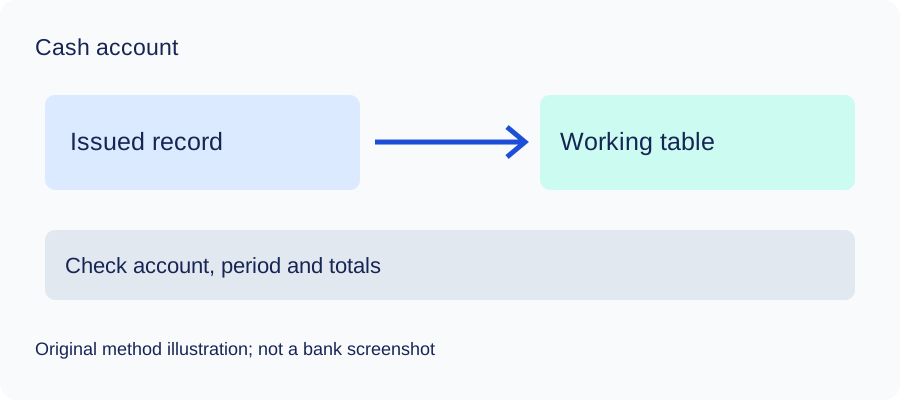
This step starts with a suitable original already in your possession. It does not establish an unverified bank download control. Keep that file unchanged and make a separate working table. A native export that already supplies the required account, dates and detail can bypass PDF conversion.
Manual route: build and check the table
- Open the original in a trusted local viewer. Record the account alias, currency, printed start/end and any page references in a private source register. Read the complete transaction section, including continuation pages.
- Decide what the source calls each date. Use the posted date when that is the chosen task; if another relevant date is present, retain it in an additional private worksheet column. Do not use the file's download date as a transaction date.
- Create a working sheet with
date,description,amount. Transcribe each included posted movement once. Join a description continuing onto another line only when it belongs to that same movement. Do not insert section headers, carried balances or summary totals as transactions. - For this deposit cash table, use positive inflows and negative outflows. Read the actual source's debit/credit or sign convention before mapping it. Do not assume a borrowing or card balance uses the same convention. Keep different accounts and currencies separate.
- Compare the worksheet with the original page by page. Mark each source movement checked once; inspect dates, description text, decimal points and signs. If text selection loses columns or joins unrelated lines, transcribe from the visible original instead. If a scanned or unclear page cannot be read reliably, obtain a clearer copy or leave the affected rows unresolved.
- Save a separate CSV working copy using your editor's CSV format. Inspect the actual delimiter and encoding; changing a file extension does not create a CSV. The small comma-delimited example below shows the chosen fields, not bank-export headers. Preserve any richer private worksheet columns separately if the three-field copy omits information you need.
Optional LocalExtract route: inspect output before importing
Open LocalExtract and select one PDF for the operation. Let the local parser/OCR process it, inspect the resulting transaction table against every relevant page, and export CSV. The current export contains date,description,amount; it does not supply a complete replica of every field in the original. Compare dates, signs, missing or duplicate movements and continued descriptions before relying on it. The original remains the authority for this check. No actual bank PDF or output was tested for this guide, so neither the public help route nor the invented exercise establishes extraction compatibility.
Keep any unresolved row out of a claimed complete reconciliation. A visually plausible table and an equal closing total can still hide offsetting errors. After the checks, import the actual CSV in Excel as described below, inspect the preview and save XLSX from Excel if a workbook is needed. LocalExtract does not export XLSX directly.
Choose dates and amounts, then inspect the Excel import
For a deposit cash account, use positive inflows and negative outflows after reading the original's actual convention. Keep another needed date, currency and source reference in additional private worksheet columns; the three-field CSV does not encode them automatically. One entirely invented comma-delimited example is:
date,description,amount
2026-09-01,Example receipt,250.00
2026-09-02,"Example purchase, supplies",-100.00
2026-09-03,Example fee,-10.00
These are chosen learning fields, not the bank's native headers or a tested statement layout. The comma in a description is protected by quotes, consistent with RFC4180. In Excel use Data → From Text/CSV, inspect delimiter, date types, decimal amounts and signs, then load. Microsoft's import help explains the preview. Save XLSX in Excel after checking.
When the source supplies comparable endpoints for the same complete account/currency/interval, compare opening plus signed movements with closing. A filtered subset, loaded fragment or different interval cannot be reconciled as that complete cycle. Without comparable balances, record that limit and check every row; an equal net total cannot prove each date or description.
Check the method with invented records
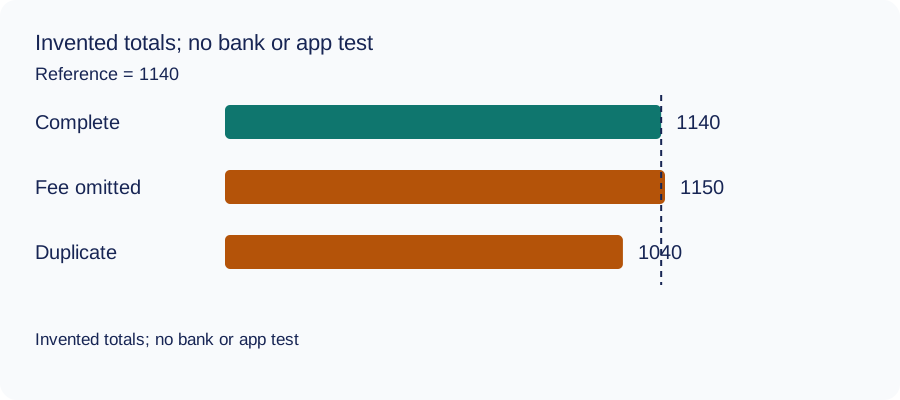
We recomputed three deliberately constructed cases on October 11, 2026 using decimal arithmetic: complete rows, an omitted fee and a duplicated movement. The reference total and every number are invented. This checks the reconciliation method only: no bank account, real PDF, OCR result or LocalExtract output was tested. The same learning aid is used across these guides.
| Case | Calculated closing total | Difference from reference |
|---|---|---|
| Complete rows | 1140 | 0 |
| Fee omitted | 1150 | 10 |
| Movement duplicated | 1040 | -100 |
Illustrative units, not a real account balance.
Download the blank document checklist or synthetic check data. CSV · JSON.
Frequently Asked Questions
Does new NetBank still offer CSV?
The current feature page confirms CSV and says OFX/QIF are removed in the new interface.
Is CSV already an XLSX workbook?
No. Import it and save XLSX from Excel after checks.
Is a universal export range established?
No. Check the actual offered dates, filters and fields.
Was a CommBank PDF tested?
No. Public route verification and invented arithmetic do not establish extraction compatibility.
If PDF is the relevant source
LocalExtract processes one PDF at a time on the device and exports CSV with date,description,amount. Parsing and OCR do not require uploading the statement. This is a working table that needs comparison with the original; no bank compatibility was validated here. There is no direct XLSX, QBO or OFX export, bulk queue or automatic accounting sync. To obtain XLSX, import the checked CSV and save from Excel.
The free evaluation covers ten pages in total. Pro is USD 10/month or USD 60/year. Account, subscription, update and periodic Pro checks need network access. See downloads and product scope.
Sources and verification scope
Public official guidance checked October 11, 2026. Account controls, document availability and bank layouts were not authenticated-tested. The method exercises use invented records, not actual bank samples or measured extraction results.
Updated October 11, 2026: Added task-specific source decisions, date/amount examples and CSV import checks. No bank format or app output was validated.
Keep the source task and product conditions explicit, preserve the original and leave missing records or rows unresolved. Check the actual file before using it.
For the next task, see the same bank’s document collection guide.
LocalExtract Team
We build LocalExtract, a desktop bank statement converter. Questions or corrections? Contact · Editorial policy