
Barclays UK Statements to Excel: PDF Copies, Duplicates and CSV Checks
Updated · 6 min read
Choose one original per account and printed period before making a working table. This guide covers the UK product and the task described below.
The desktop apps export date, description, and amount as CSV. Open CSV in Excel to save an XLSX workbook. Statement support varies: verify the result against your own PDF.
Choose one source for each cash-account period
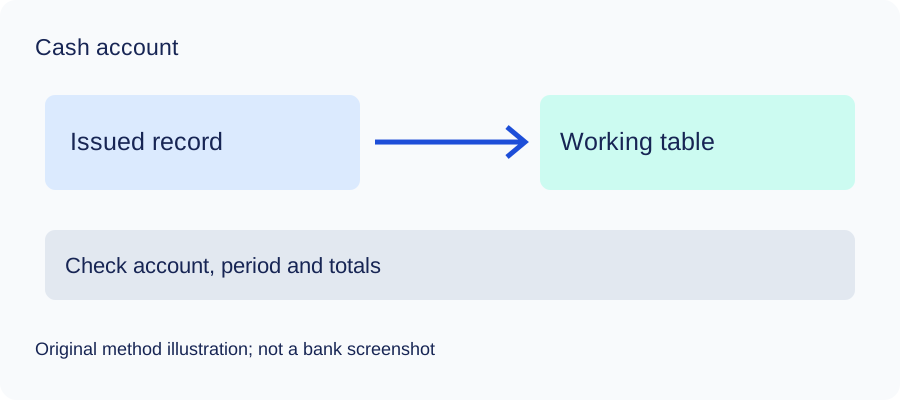
This task is for a UK personal account holder analysing posted cash movements in Excel. A source register is a private list linking an account alias and printed period to the original document. It is not a bank export. An issued cycle is the interval inside the PDF, not a month guessed from a filename.
Barclays' online guide uses Profile → My Barclays documents, while its save/print FAQ also lists Manage accounts → Statements and documents. Preserve the file for the actual account and period using the PDF collection guide. These public routes do not establish a current personal native CSV menu. Unknown does not mean unavailable: inspect any transaction format offered for your account and use it when its coverage suits the task.
The current app is being updated in phases. A changed menu name does not by itself mean a new source period. Keep the issued PDF unchanged and make analysis in a separate file.
Count duplicate document copies before counting transactions
Consider an invented example: account-A-Aug-copy1.pdf and account-A-Aug-copy2.pdf came from two document entry points, while account-A-Sep.pdf is a different period. The August names are different, but their printed account and cycle match. That is three files covering two periods, not three periods. This is an editorial example, not an observed Barclays file naming pattern.
- Read the account and printed start/end inside each original.
- Link every copy to that account-period identity in the source register.
- Choose one verified original for conversion; mark the other as a duplicate copy without altering either bank record.
- Keep genuinely separate periods even when a payment date, amount and description happen to repeat.
| Evidence | Decision | Unsafe shortcut |
|---|---|---|
| Two filenames, same account and printed cycle | Review as duplicate document copies | Import both because names differ |
| Same amount/date in two source rows | Compare actual rows and source context | Delete automatically as a duplicate |
| Different printed periods with overlapping activity | Check the overlap before combining | Sum both files without a source reference |
A matched total can hide duplicate and missing rows that offset one another. Verify source identity first, then every relevant row.
Create and import a deliberately defined working table
For the selected deposit account, define positive amounts as posted inflows and negative amounts as outflows. Preserve the date meaning stated by the source. Keep account alias, currency and source period in worksheet notes; another date or source-page reference can be added manually. No actual Barclays headers, PDF layout or LocalExtract output was validated.
date,description,amount
2026-09-01,Example receipt,250.00
2026-09-02,"Example purchase, supplies",-100.00
2026-09-03,Example fee,-10.00
These rows are invented. Import CSV using Data → From Text/CSV, check delimiter, dates, decimal amounts and comma-containing descriptions, then load. See Microsoft's import guide and RFC 4180 for the quoting rule. Save XLSX from the checked table in Excel; renaming a CSV does not convert it to a workbook.
Only use opening plus signed movements against closing when account, currency and complete cycle match. A missing fee, duplicate source import or filtered range requires investigation, never an invented balancing entry. Do not apply this cash convention to a Barclaycard liability or infer investment quantities from a bank balance.
Check the method with invented records
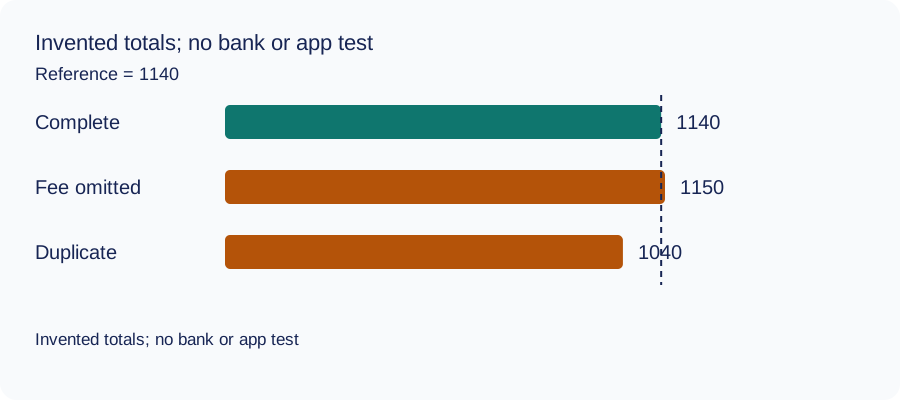
We recomputed three deliberately constructed cases on October 11, 2026 using decimal arithmetic: complete rows, an omitted fee and a duplicated movement. The reference total and every number are invented. This checks the reconciliation method only: no bank account, real PDF, OCR result or LocalExtract output was tested. The same learning aid is used across these guides.
| Case | Calculated closing total | Difference from reference |
|---|---|---|
| Complete rows | 1140 | 0 |
| Fee omitted | 1150 | 10 |
| Movement duplicated | 1040 | -100 |
Illustrative units, not a real account balance.
Download the blank document checklist or synthetic check data. CSV · JSON.
Frequently Asked Questions
Does another menu produce another statement?
Not necessarily. Compare the account and printed cycle inside the files before counting distinct records.
Has a native personal CSV route been ruled out?
No. It was not verified by these sources. Inspect actual offered bank formats and coverage rather than assuming conversion is mandatory.
Can I remove every repeated date and amount?
No. Separate payments can legitimately repeat those fields. Review their original source context.
Does LocalExtract produce XLSX directly?
No. It exports CSV. Import the checked CSV and save XLSX in Excel.
If PDF is the relevant source
LocalExtract processes one PDF at a time on the device and exports CSV with date,description,amount. Parsing and OCR do not require uploading the statement. This is a working table that needs comparison with the original; no bank compatibility was validated here. There is no direct XLSX, QBO or OFX export, bulk queue or automatic accounting sync. To obtain XLSX, import the checked CSV and save from Excel.
The free evaluation covers ten pages in total. Pro is USD 10/month or USD 60/year. Account, subscription, update and periodic Pro checks need network access. See downloads and product scope.
Sources and verification scope
Public official guidance checked October 11, 2026. Account controls, document availability and bank layouts were not authenticated-tested. The method exercises use invented records, not actual bank samples or measured extraction results.
Updated October 11, 2026: Added task-specific source decisions, date/amount examples and CSV import checks. No bank format or app output was validated.
Choose one verified original per account and period, preserve a source register and resolve duplicated imports before relying on totals. Use a suitable native table if the bank offers one.
LocalExtract Team
We build LocalExtract, a desktop bank statement converter. Questions or corrections? Contact · Editorial policy